
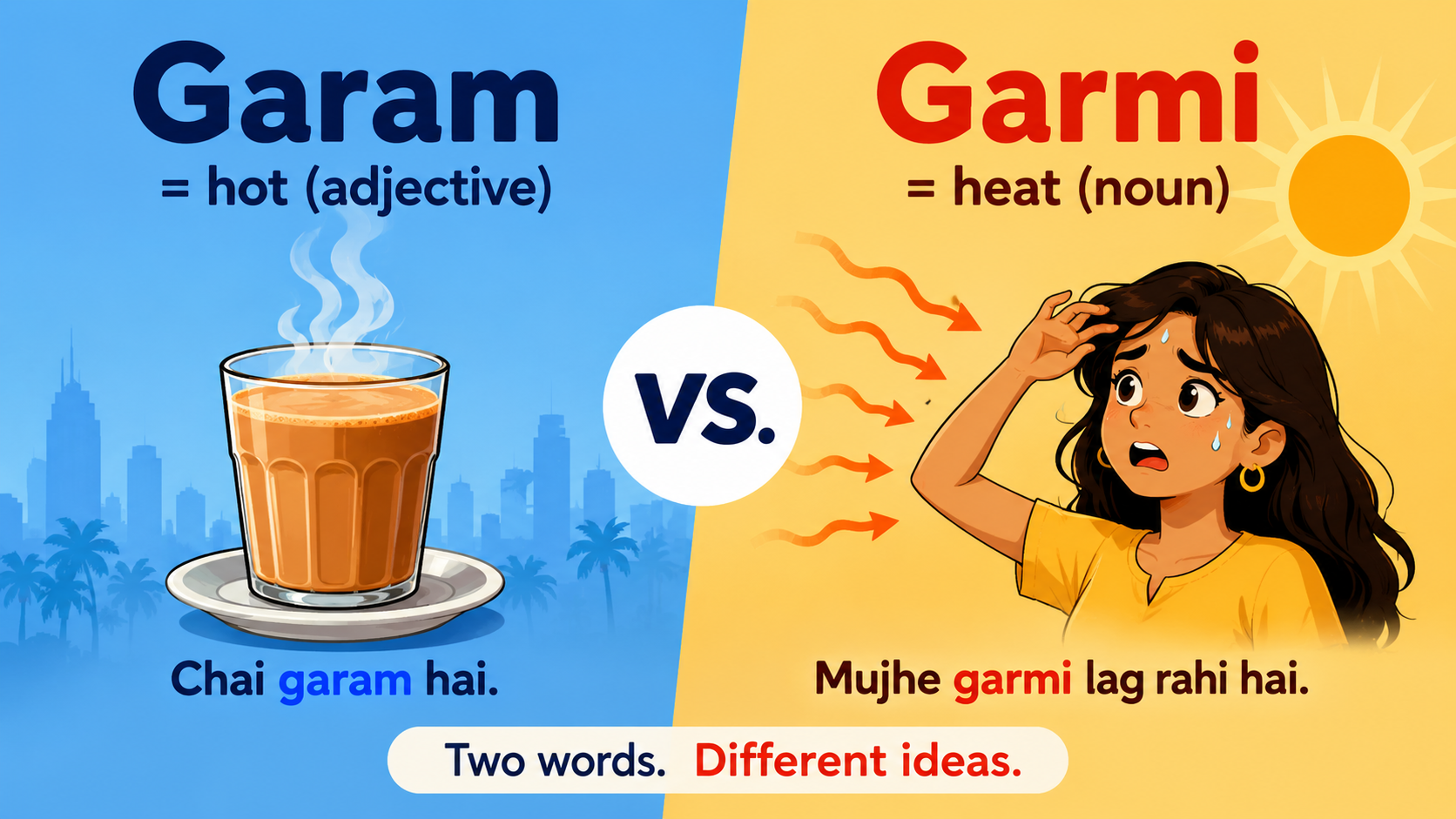
Garam = hot (adjective)
Garmi = heat (noun)
I remember when I was learning Hindi and I’d hear my mom describe the weather as Garmi but chai as Garam. I was confused and curious. I’d ask her, “What’s the Difference Between Garam and Garmi? Why is the weather Garmi but chai Garam?” Honestly, she couldn’t explain. She just knew that that’s what it is.
In both cases, Garmi and Garam seem to be describing something – the weather and chai. Then I wondered if it had something to do with weather/chai being masculine or feminine nouns. But that didn’t make sense either as chai is a feminine noun so wouldn’t it be “Chai garmi hai”?
Upon further study I came to understand that I was applying English patterns to Hindi.

Hindi often expresses physical conditions using nouns (“heat,” “cold,” “hunger”) that are experienced by a person, whereas English more commonly uses adjectives (“hot,” “cold,” “hungry”) attached directly to a subject.
So “Aaj garmi hai” translates to, “Today heat is,” where heat exists as a thing — a noun.
When we say “Chai garam hai”, it translates to, “Chai hot is”; where hot is an adjective that describes the chai.
Of course, in natural English we don’t say, “Today heat is” and “Chai hot is” and that is the distinction between translation and meaning.
What other ways do we use the noun Garmi?
To say, “I’m hot”, as in, I am feeling hot.
Scenario: It’s Game 7 of the NBA Finals, the Lakers have a high stakes game at Crypto.com Arena this afternoon. They’re 3-3 (I WISH! I wrote this blog on May 12, 2026 — the day after the Lakers’ crushing playoff exit.)
Okay, back to our scenario. You’re going to the game on a hot LA afternoon. Your cousin from Saket is visiting – you two are walking to the arena and you say, “I’m so hot”. Do you say:
Main garmi hoon
Main garam hoon
Main garmi hoon = I am heat. (…so that’s a no.)
Main garam hoon is grammatically possible BUT in actual conversation sounds unintentionally suggestive and odd. It’s not a conversational way to say, “I feel hot”.
We need to shift the sentence to, “I am feeling hot” — Mujhe garmi lag rahi hai.
Mujhe garmi lag rahi hai does not mean, “I am feeling hot”. It literally means, “Heat is being felt by me,” but in natural English we simply say, “I am hot”.
Hindi often treats physical sensations as experiences happening to you:
Mujhe thand lag rahi hai = Cold (n.) is being felt to me; Natural English = I feel/am cold.
Mujhe bhookh lag rahi hai = Hunger (n.) is being felt to me; Natural English = I’m hungry.
Mujhe pyaas lag rahi hai = Thirst (n.) is being felt to me; Natural English = I’m thirsty.
This reflects a different way Hindi often conceptualizes physical sensations and experiences, compared to English. Hindi often emphasizes sensations arising or being felt, whereas English often simplifies them into static adjective-based states: “I am cold/hungry/thirsty.”
States-of-Being vs. Physical Sensations
Hindi makes a distinction between states-of-being vs. physical sensations.
States-of-being are treated more like descriptions of a person’s condition, mindset, or emotional state.
These sensations are treated more like experiences arising within the body rather than qualities that define the self.
States-of-Being
- Khush (happy)
- Udaas (sad)
- Tayaar (ready)
- Naraaz (upset)
Physical Sensations
- Garmi (heat)
- Bhookh (hunger)
- Pyaas (thirst)
- Thand (cold)
- Neend (sleepiness)
Happiness is treated more like a personal state or identity description, whereas hunger is treated as an experience or sensation arising within the body. Of course, there are exceptions to this pattern, but conceptually it helps explain why we say:
Main theek hoon vs. Mujhe garmi lag rahi hai.
Main = “I”
Main places “I” at the grammatical center of the sentence:
- Main theek hoon = I am okay
- Main achha hoon = I am good
- Main badiya hoon = I am great
But Hindi often shifts physical sensations away from the self and toward the experience itself:
- Mujhe garmi lag rahi hai = Heat is being felt by me.
Mujhe means “to me” or “me”, BUT in natural English we often translate it to “I”. And, this is why main vs. mujhe is one of the most challenging aspects of Hindi for English speakers to grasp.
For example:
Mujhe ladoo pasand hain. = Ladoo is liked to me.
Mujhe gulaab jamun chahiye. = Gulaab jamun is wanted to me.
Mujhe is for when the person is experiencing/desiring/perceiving something rather than actively doing it. Hindi extends this pattern beyond physical sensations into preferences, desires, cravings, and needs.
Fun Conversational Hindi Classes for Kids and Adults Outside India
✔ Conversational Hindi
✔ Vocabulary & grammar
✔ Indian culture & traditions
✔ Real-life speaking skills
Our students build confidence speaking Hindi with:
- parents
- grandparents
- relatives
- family friends
- the Uncle at the Indian grocery store!
All classes are live on Zoom.
Students join us from across the globe — from California to Singapore.

Meet Samta Aunty
Have you ever watched a Bollywood movie and everyone else was laughing and…you didn’t understand the joke? Or maybe your grandparents speak to you in Hindi…and your response is a sweet smile and “theek hain” to everything?
That was me too.
Growing up in Orange County, California, I understood Hindi long before I confidently spoke it. But over time, I became curious. Friday nights became “Hindi movie nights” with my mom — parathas, Bollywood movies, and LOTS of questions.
Eventually, I started speaking more Hindi at home.
One of my favorite memories was visiting family in Delhi when my Chachi said: Tumhari Hindi bahut achi hai.
That was a moment for me.
I started Virtual PreSkool to make learning Hindi accessible to children and adults residing outside India. To build confidence speaking Hindi and feel more connected to their family, culture, and heritage.
One of the best parts of teaching is hearing students excitedly share:
- “My Nani cried when I said “pranam”!
- “When we were in India my dad didn’t know how to ask for directions, but I did!”
After graduating from UC Irvine and earning my MBA from USC Marshall, I spent years as an entrepreneur before creating Virtual PreSkool.
When I’m not teaching Hindi, I’m usually exercising, cooking vegan meals, or planning my next trip. I look forward to seeing you in class!
Leave a Reply