
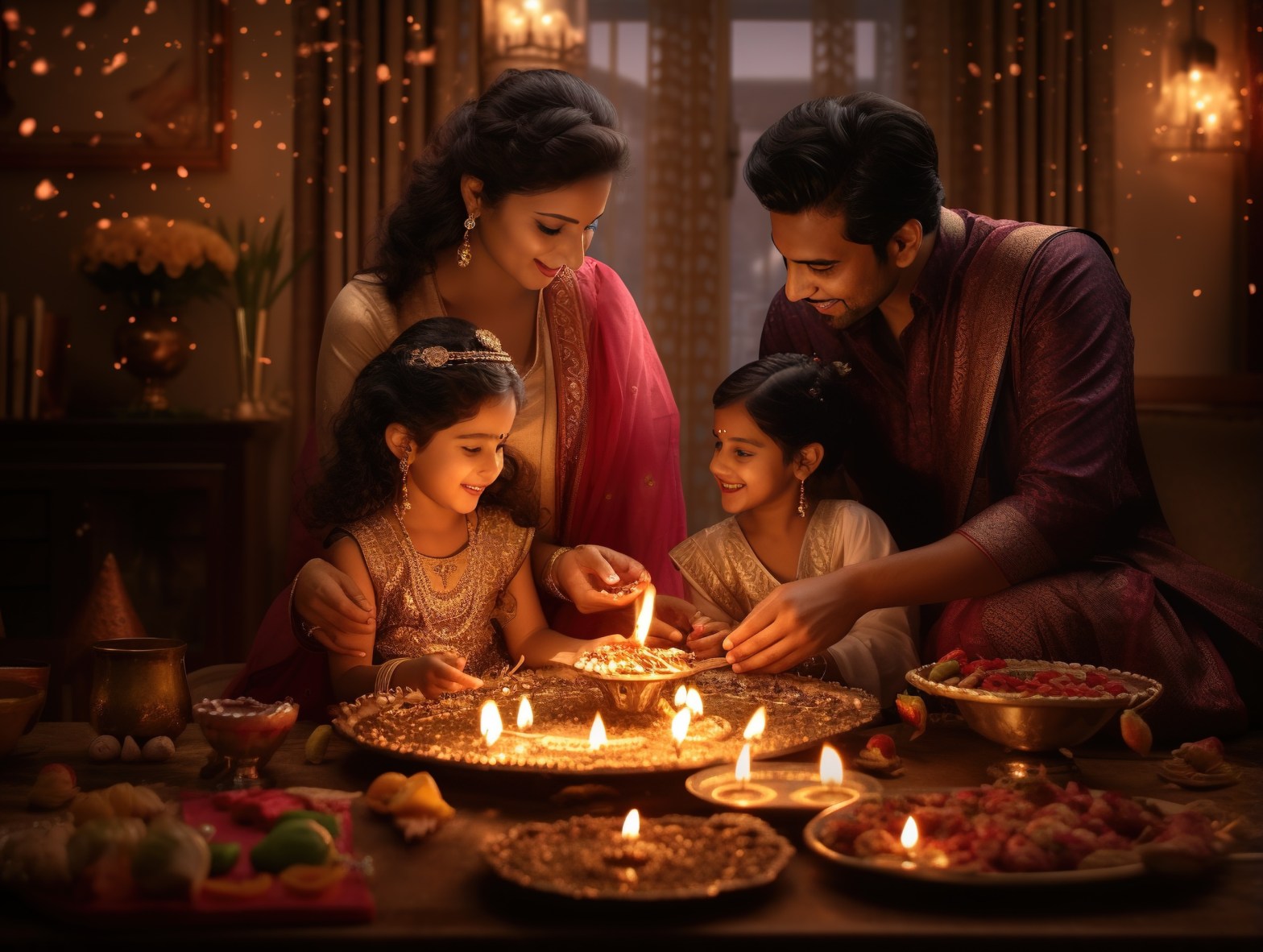
In this article I will share a simple way of how to explain Diwali to kids that centers around them. It will get them thinking about how they can apply the lessons of Diwali to themselves and everyday life.
Inside:
What is Diwali?
Why is Diwali Celebrated? (Hinduism, Jainism, Sikhism)
Spirit of Diwali
What does Diwali mean?
When is Diwali?
The 5 buckets of Diwali
Health
Knowledge
Achievements
Friendship
Family
Names of 5 days of Diwali
Navratri vs. Dussehra vs. Diwali
Indian Clothes
Is that Krishna, Vishnu or Shiv?
Diwali Vocabulary Flashcards
Diwali Books, Stickers, Toys
Diwali Cartoons
What is Diwali?
Diwali is a festival. It’s a celebration from India.

And it’s a BIG deal in India. You know how Christmas is celebrated with decorations and lights and food, gifts, parties, and many people go to church? Well, Diwali is like the Christmas of India and Hindus, Jains, and Sikhs across the globe.

Why is Diwali Celebrated?
Diwali has significance in 3 religions, which are all from India. It has significance in Hinduism, Jainism, and Sikhism.

Significance of Diwali in Hinduism. In Hinduism, Diwali is a celebration of good triumphing over bad. Candles, called diyas, are lit to symbolize the removal of darkness from one’s life to make way for light. The light from the candle represents – happiness, goodness, and knowledge.
One of the most important events of Diwali is the celebration of the return of Ram, Sita and Lakshman, to their home in Ayodhya, after living in the forest for 14 years. Ram stopped the bad guy Raavan. You can listen to the full story, in American-English, in the video below (starts at 13:52)

Significance of Diwali in Jainism. In Jainism, Diwali is a celebration of when the 24th Tirthankar, Bhagwan Mahavir, attained Nirvana or, in English, enlightenment. Listen ton the full story in this video.
Significance of Diwali in Sikhism. In Sikhism, Bandi Chor Divas is on Diwali. Bandi Chor Divas means the day of liberation. This is the day that the 6th Guru, Guru Har-gobindji and 52 Hindu princes were freed from prison and were given a hero’s welcome, with hundreds of diyas lit, when they returned to Amritsar Sahib. Hear the full story in the video below.
So as you can see, Diwali has a lot of importance across different religions.
The Spirit of Diwali
The spirit of Diwali is about tapping into our best selves and sharing that with family, friends and your community.
What does “our best selves” mean? It means:
sharing
caring for others
helping others without expectation
kindness
patience
curiosity
Just like the Kapoor kids and family were there for Guard Chacha to turn his lonely Diwali into a love-filled celebration, in the cartoon below.
What Does Diwali Mean?
Before we jump in, let’s talk about the word “Diwali”. Many people think that Diwali means the Festival of Lights. But that’s what Diwali is. What the word, “Diwali” means is, a row of lights or candles/lamps called diya’s.
Also, it is called Diwali in northern India. In southern India it is more commonly called Deepavali. The meaning the same – a row of lights.
Do you know someone named Deepa or Deepak? Do they kinda sound like diya? These names mean light, or source of light and brilliance.

When is Diwali?
The date of Diwali changes every year. Why? Because the date is based on the cycles of the moon. You might have learned about moon cycles in school. The date of Diwali is when there is a New Moon. A New Moon occurs when the Sun and the Moon are both on the same side of the Earth, as you can see below.
As you can see from the picture, a New Moon is hardly even visible! If you go out on the night of Diwali and look at the sky, you probably won’t see the moon.
Diwali is usually sometime in October or November. Below you’ll find the dates for several years.

This is a great cartoon for kids, that explains the phases of the moon.
Diwali Dates 2024-2035
| Year | Diwali | Day |
| 2024 | November 1 | Friday |
| 2025 | October 20 | Monday |
| 2026 | November 8 | Sunday |
| 2027 | October 29 | Friday |
| 2028 | October 17 | Tuesday |
| 2029 | November 5 | Monday |
| 2030 | October 26 | Saturday |
| 2031 | November 14 | Friday |
| 2032 | November 2 | Tuesday |
| 2033 | October 22 | Saturday |
| 2034 | November 10 | Friday |
| 2035 | October 30 | Tuesday |
The 5 Buckets of Diwali
Did you know that Diwali is not 1 day? It’s actually a 5 day celebration. Think of each day as a life bucket. And, together the 5 buckets create a happy and fulfilling life.
The 5 days of Diwali remind us to be appreciative and happy for what we have as well as encourage us to continuously learn and evolve.

So what are the 5 buckets? They each contain something pretty much all people want:
- 1st bucket = Health – we all want to be healthy so that we can play outside, jump in puddles, and make sand castles, right?
- 2nd bucket = Knowledge – learning and building knowledge helps us make good choices and decisions. Knowledge is power. The more we know the better we can be in school and activities and that makes us better people.
- 3rd Bucket = Achievements – Doesn’t it feel good to ace a test? or win an award? That comes with having something that you are working towards. And after achieving something, we set new heights for ourselves to continuously grow. Achievements and continuously growing, makes us better people.
- 4th Bucket = Friends – to play with, make each other laugh, share ideas, and help each other.
- 5th Bucket = Family – Family takes care of each other. When your brother or sister gets hurt, you care right? You want them to feel better and do things so that they do. And they do the same for you.
Your job is to fill each of your buckets. When you’re young, your parents help you. And as you grow and get bigger, more and more of the responsibility to fill your bucket is on you.
So here are the 5 buckets:

Each bucket of Diwali has a story behind it involving Gods who are heroes that overcome challenges – where good wins; and bad loses. These fantastic and entertaining tales embed lessons that can be applied to every day life. They teach us about being grateful, teamwork, giving to others, making good choices, self confidence, and so much more.
How to Explain Diwali to Kids – Day 1, Health
The first lesson and first day of Diwali reminds us to take care of our health. Health impacts…everything; and that’s why the 5 days of Diwali start with this reminder.
The story is that on the first day of Diwali people were gifted health. Demons had taken over the whole universe – even the heavens.

The only way to make the universe good again was for a special potion to spread across the sky. This special potion is called amrita. But the amrita was buried deep, deep inside the ocean and it had to be dug out, somehow.

The only way to get it out was to churn all of the water in the ocean. What does churn mean? It’s kinda like mixing pancake batter. Mixing pancake batter is easy. But mixing a whole ocean!?…Not so easy.

So the demons and the Gods actually worked together! (Teamwork makes the dream work). But wait a second, didn’t this whole situation happen because the demons took over heaven?? Yep.
Then why would the Gods work with the demons? Well, they each had a common goal – to get the amrita.
So, they got a big mountain and wrapped Vasuki around it. Who’s Vasuki? That’s Shivji’s giant serpent. And they used Vasuki like a rope to have an epic tug-of-war.
Tugging back-and-forth made the paani (water) churn; I gotta have some Hindi vocabulary words sprinkled in here…I mean, duh, I’m a Hindi teacher.

Finally, the amrita came out of the paani. But that wasn’t the only thing that came out. Lord Dhanvantari, emerged as well, and he spread the gift of Ayurved – health – across the sky. And that day he gifted health to the universe.

Thus the first bucket of Diwali is health. It reminds us to take care of our health as it is precious. The other lessons in this story are:
- Finding solutions to problems
- Working well with others – sometimes even with people you disagree with
Keeping your mind and efforts focused on the task
How to Explain Diwali to Kids – Day 2: Knowledge
The second day of Diwali is about knowledge. We start life by gaining knowledge from our parents who teach us by example and through their love and actions. Our parents, grandparents, elders, teachers and coaches teach us throughout life.
The story of the 2nd day of Diwali is about a prince who was really really bad.

His parents taught him to do good things and help people. But he didn’t listen.

And he did a lot of bad things.

He did so many bad things, that finally Krishna had to stop him.

This story serves as a reminder to listen to the wisdom and guidance of our elders. They have experienced more of the world. They shower us with their knowledge, wisdom and blessings and want the best for us so that we grow up to be good citizens of the world.
How to Explain Diwali to Kids – Day 3: Achievements
This is the main day of Diwali and has the most famous Diwali story – Ramayan. Please note that this is a super simplified version of the story. Again, the goal is for your child to know the basics and take aways. And you can listen to my full version of the story in this video (starting at 13:52).
Also, note that the spellings and simplifications are there to make it easier for your child(ren) to understand and pronounce Hindi words properly.
There are 5 key characters:
Ram, is a young and noble prince.

Ram is married to Seetha.

Ram has a little brother named Lakshman who loves his Bhaiya very much.

Raavan is the bad guy.

Raavan has a little sister named Srupankha. She is not a nice lady.

One day Srupankha asked Lakshman to marry her.

But he said “no thank you”.

That made Srupanka angry.

And she told her brother, Raavan.

Now Raavan was angry too and wanted revenge for being insulted by this rejection.

So Raavan kidnapped Seetha. Seriously?! Not cool.

When they discovered that Seetha was missing, Ram and Lakshman went to look for her. Seetha had smartly, dropped her necklace to give them a clue as to which direction she went.

And they got help from a new friend named Hanuman.

Ram stopped Raavan and got Seetha back. Go Ram!

After that big ordeal, the 3 of them headed home. Hanuman went ahead of them and informed everyone in Ayodhya that Ram, Seetha and Lakshman were coming home.
To welcome them home, the villagers lit their pathway with homemade candles called diyas. The purpose was 1. to guide them as this was super long ago and there were no street lights. And 2. To represent that after a long time, the unhappy and dark times of Raavan were over and now it was time to let the light in, a time for new beginnings, happiness and hope.

This is why Diwali is called the Festival of Lights. By lighting candles we remove darkness in our hearts and minds and bring in the light to love and learning.
How to Explain Diwali to Kids – Day 4: Friendship
Having friends is not only fun and brings us happiness, but it’s good for overall health. Krishna had a lot of friends in his home town of Vrindavan. He cared about all of them and they cared about him too.
This story of Diwali starts with the God of Rain and Thunder — Lord Indra. His job was to bring rain to farmers every year so that their crops would grow.

Every year the farmers did a prayer ceremony (pooja) to ask him to bring the baarish (rain)…even though it was his job to do that.

One year, convinced by Krishna, the farmers did not do the the pooja in his honor.

This made Lord Indra angry…especially when he learned that it was a little boy (Krishna) that convinced everyone not to do the pooja. He didn’t know that Krishna isn’t just a little boy.

He decided to punish them with a down pour of so much baarish (rain) that there were floods! Everyone was scared. Well…everyone except Krishna.

Krishna saved everyone by holding up a mountain like it was a giant umbrella….for 7 days

Finally Lord Indra apologized to Krishna.

Krishna saved his friends and his community. He also stood firm in doing the right thing while Lord Indra’s ego got the better of him.
This story about Krishna teaches us to:
1. stand up for what’s right
2. stand up to a bully
3. take care of community
How to Explain Diwali to Kids – Day 5: Family
The fifth day of Diwali celebrates the love between brothers and sisters. It teaches us that siblings share a responsibility take care of each other. And the 5th day celebrates the lifelong bond of siblings.
Do you remember the bad prince from day 2 of Diwali? The one that Krishna stopped? Well, when Krishna returned home, his sister Subhadra was waiting for him. She was worried about him after being involved in a big battle. She bandaged his wounds and made his favorite foods and sweets.
She put the red powder called teeka, on his forehead and wished for his long life.

Each bucket of Diwali has an important story with lessons that we can each apply to our own life.
Names Of the 5 Days Of Diwali
Now that you have learned about each bucket and each day of Diwali I want to share the names of each of these days with you.
These are for your knowledge these are what each of the 5 days of Diwali are called, but I wouldn’t recommend using these while explaining Diwali to little children (high school or younger)…at least not at first, as these are unfamiliar words that will confuse them.
Depending on, or as your child understands Diwali more, I’d suggest introducing these words accordingly.
Day 1: Dhanteras
Day 2: Choti Diwali aka Chaturdasi
Day 3: Diwali
Day 4: Govardhan Pooja
Day 5: Bhai Dooj aka Bhai Beej

Navratri vs. Dussehra vs. Diwali
You might have heard of each of these and if you’re confused, I don’t blame you. Let’s clarify what each of these are and how they relate to each other.
Navratri (Nav-raath-ree) means 9 nights. It refers to the 9 days of battle between Ram’s army and Raavan’s monster army.

Dussehra is the day that Ram killed Raavan. Many people confuse this for Diwali. But the day Ram killed Raavan is called Dussehra (Da-shayra). And it’s on the last night of Navratri. And Dussehra is approximately 2.5 weeks before Diwali.


So then what is Diwali?
Diwali is the day that Ram, Seetha and Lakshman returned home, to Ayodhya, after 14 years.

This chart sums up how Navratri, Dussehra and Diwali relate to each other.

Indian Clothes
One of the most fun (as long as the clothes aren’t itchy) and visible aspects of Diwali is wearing Indian clothes.
How To Tell The Difference Amongst Krishna, Vishnu, and Shivji
Kids often find it challenging to distinguish among Krishna, Vishnu, and Shivji since they are all neela (blue). I created this image to make it easy for kids to see how they are different, so that next time they see one of these Gods, they will know who it is.

Diwali Flash Cards
Feel free to download them and/or watch the video to practice.
Diwali Books, Stickers, Toys
Books
Seeking Sita
Celebrating Diwali
Binny’s Diwali
Diwali (Celebrate the World)
The Story of Diwali
Let’s Celebrate 5 Days of Diwali
Happy Diwali! (Peppa Pig)
The Best Diwali Ever
It’s Diwali!
Baby’s First Diwali
Shubh Diwali!
Diwali In My New Home
Happy Diwali Mad Libs
Archie Celebrates Diwali
Diwali 50 Activity Book
The 5 Days of Diwali
Let’s Learn About Ramayana
Simba’s First Diwali
Amma, Tell Me About Diwali
My Diwali, Lights of Virtue
Let There Be Light
Coloring Book
Diwali Cartoons
Virtual PreSkool has no affiliation with any of these products. There are no affiliate links.
Summary
In How to Explain Diwali to Kids we explored easy-to-understand concepts about what Diwali is, what it means, why it’s celebrated, When it is, what each of the 5 days of Diwali means and how you can apply those lessons to your own life.
In addition we talked about clothes to wear at Diwali
In addition to the explanations there are a number of resources in this article including flashcards, books, stickers, toys and cartoons. I hope this festive season brings you and your family laughter and prosperity. Diwali ki shubhkamnaye! Happy Diwali!
Wishing you and yours a very Happy Diwali!

Fun Conversational Hindi Classes for Kids and Adults Outside India
Thanks for reaching out!
Have you ever watched a Bollywood movie and everyone else was laughing and…you didn’t understand the joke? Or maybe your grandparents speak to you in Hindi…and your response is a sweet smile and “theek hain” to everything?
That was me too.
Growing up in Orange County, California, I understood Hindi long before I confidently spoke it. But over time, I became curious. Friday nights became “Hindi movie nights” with my mom — parathas, Bollywood movies, and LOTS of questions.
Eventually, I started speaking more Hindi at home.
One of my favorite memories was visiting family in Delhi when my Chachi said: Tumhari Hindi bahut achi hai.
That was a moment for me.
I started Virtual PreSkool to make learning Hindi accessible to children and adults residing outside India. To build confidence speaking Hindi and feel more connected to their family, culture, and heritage.
One of the best parts of teaching is hearing students excitedly share:
- “My Nani cried when I said “pranam”!
- “When we were in India my dad didn’t know how to ask for directions, but I did!”
After graduating from UC Irvine and earning my MBA from USC Marshall, I spent years as an entrepreneur before creating Virtual PreSkool.
When I’m not teaching Hindi, I’m usually exercising, cooking vegan meals, or planning my next trip. I look forward to seeing you in class!